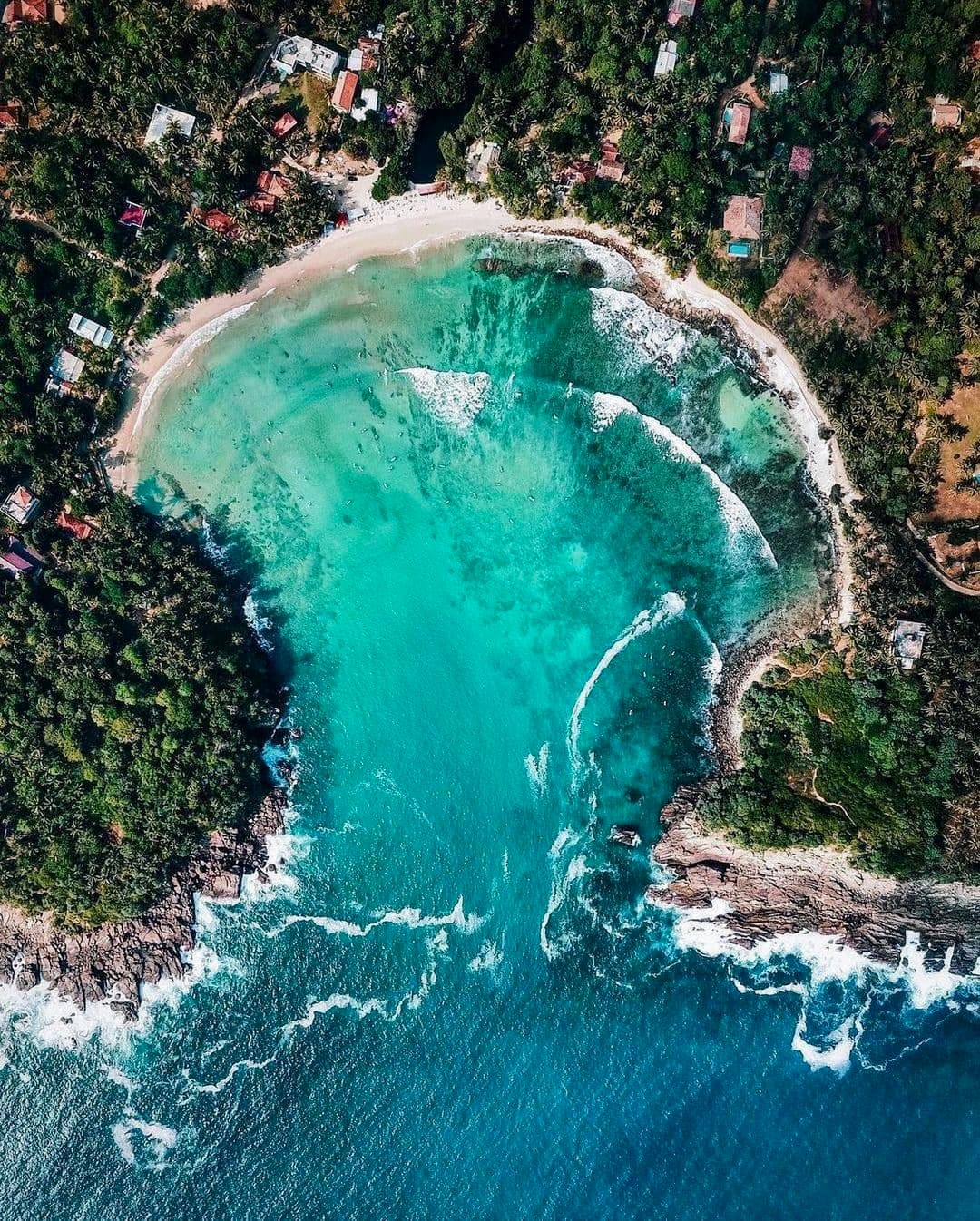
Anuradhapura was a functioning capital city when Rome was still a village. The chronicles that describe its kings, its waterworks, and its Buddhist councils are among the oldest continuous historical records on earth. This journey moves through the ancient triangle --- sacred cities, jungle temples, wild leopard country --- before descending south to the coast. For the guest who wants to understand what they are seeing, not just see it.
Negombo
The gateway with a story of its own.
The gateway that is worth staying for.
Most guests pass through Negombo without pausing. That is a mistake. The lagoon town just north of the airport carries centuries of Portuguese and Dutch colonial history, a fishing culture so old its methods predate European arrival, and a morning fish market that begins before dawn and is finished before the tourists wake.
Arrive before 5.30am. The catch arrives by boat and is auctioned within the hour. Entirely authentic --- commerce that has operated identically for generations.
The Negombo Lagoon at dusk --- Chinese fishing nets lowering and rising, egrets crossing the sky --- is the island's first quiet moment and one of its best.
The remains of the Dutch fort and the canal built to transport cinnamon. A slow walk at golden hour reveals the colonial geography of the town.
Built by the Portuguese in the 16th century, rebuilt by the Dutch. Ceiling paintings are remarkable. The fishing community that fills it on Sunday mornings is more remarkable still.
The freshest catch in Sri Lanka is here, not on the southern coast. Lagoon prawns, grilled fish, coconut sambol --- the correct introduction to Sri Lankan cuisine.
Wilpattu National Park
The leopard without the convoy. The jungle as it actually is.
Wilpattu is the largest national park in Sri Lanka and the least visited by mainstream tourism. The leopard population here is significant --- and because visitor numbers are lower than Yala, sightings happen at a respectful distance without jeep convoys. The park's defining feature is its villus --- natural lakes formed by rainwater --- surrounded by dense jungle. The park was closed for nearly two decades due to the civil conflict and reopened in 2010, having regrown without human disturbance. It is denser, wilder, and more authentic than almost anywhere else in Sri Lanka's national park system.
Unlike Yala, it is unusual to see more than three or four other vehicles on the same track. The leopard sightings at Wilpattu are quieter, longer, and more intimate.
The natural lakes support painted storks, lesser adjutants, purple herons, and multiple species of kingfisher. Slow time at a villu edge, binoculars up, in silence.
Wilpattu's elephants are wilder and less habituated to vehicles than those at Minneriya or Udawalawa.
Anuradhapura
The city that was a capital for thirteen centuries and has not finished explaining itself.
Anuradhapura was the first capital of Sri Lanka, established in the 4th century BCE and ruled continuously for over 1,300 years. At its peak it was one of the great cities of the ancient world --- a planned urban centre with advanced hydraulic systems, multi-storey buildings, and a Buddhist scholarly tradition that influenced the entire Asian continent.
Planted in 288 BCE from a cutting of the Bodhi tree in Bodh Gaya, India. 2,300 years old. The oldest documented tree in recorded human history. It is still venerated daily by thousands of Buddhist pilgrims.
A white dome 55 metres tall, built in 140 BCE. The foundations were laid on compacted sand to create an earthquake-resistant base --- a technically correct engineering solution. Walk around the base at dusk with your guide.
At its completion in the 3rd century CE, the third-tallest structure on earth after the two Egyptian pyramids at Giza. Required an estimated 93.3 million baked bricks.
Anuradhapura's engineers built an irrigation network of tanks and channels that fed hundreds of thousands of people. Many are still in use 2,000 years later.
Trincomalee
The finest natural harbour in Asia. The warmest water on the east coast.
Trincomalee's deep natural harbour has been contested by every colonial power that arrived in the Indian Ocean. The Portuguese built a fort here. The Dutch took it. The British made it the headquarters of the Eastern Fleet. What surrounds the harbour today: beaches and bays of exceptional quality, warm clear water supporting coral reef and whale shark populations.
Pigeon Island National Park, 300 metres offshore, contains the best-preserved coral reef on Sri Lanka's coast. Blacktip reef sharks, sea turtles, and reef fish in clear warm water.
The clifftop temple stands at the point where the Portuguese threw the original Hindu temple into the sea in 1624 and built a fort on its ruins. Three religions, one cliff, four centuries of history.
The waters off Trinco's east coast attract whale sharks between March and October. The largest fish in the ocean. At five metres' distance in clear water, it requires no superlatives.
Seven artesian wells of varying temperatures located 8km from Trinco. The temperature difference between adjacent wells of a few metres apart remains unexplained.
Sigiriya and Kandy
The rock that changes the way you see everything else.
There is no preparation for Sigiriya. The jungle opens and five hundred feet of ancient rock rises from the plain without ceremony. A 5th century king built a palace on its summit and decorated the sheer rock face with frescoes of extraordinary beauty. The frescoes remain. The hydraulic gardens at the base --- among the oldest landscaped gardens on earth --- still function on their original irrigation system.
Begin at dawn. The light on the plain from the summit at 6.30am is unlike anything the island offers from ground level. The climb takes 90 minutes.
Halfway up the rock, protected in a sheltered gallery --- semi-divine women painted in colours that have not faded in fifteen centuries. They must be seen slowly.
The world's earliest identifiable example of visitor commentary --- inscriptions left by visitors between the 6th and 14th centuries. Some are poetry. All are fifteen hundred years old.
The symmetrical water gardens, fed by an ancient hydraulic system that still pressurises the fountains after 1,500 years. Walk them in the early morning.
Climb the lower rock opposite for the sunrise view of Sigiriya's profile. The finest photograph available in Sri Lanka and almost no one takes it. *Kandy - The last kingdom. Still the cultural capital.* Kandy resisted European colonisation for over three hundred years. The Temple of the Tooth at its centre houses the most sacred relic in the Buddhist world. The lake beside it was built by the last king. The mountains around it make the city feel held --- cooler than the coast, operating at a rhythm that the lowlands do not share.
Three daily puja ceremonies (6am, 11am, 6.30pm) fill the air with drumming, flute, and incense. The 6am ceremony, before the tourist buses arrive, is the one worth attending.
Walk the perimeter at dusk --- the cloud wall behind the hills, the reflection of the temple lights in the water, the monks crossing the causeway.
An evening performance of Kandyan dance, fire-walking, and traditional drumming. The fire-walking sequence, which closes the programme, is performed without apparent injury.
147 acres containing one of the finest collections of tropical plants in the world. The avenue of royal palms. The giant Java fig whose single tree covers half an acre.
Ella
The village that sees everything and has decided to stay small.
Ella sits at the edge of the hill country, where the mountains drop away suddenly and the southern plain stretches to the horizon. The famous Nine Arch Bridge was built by locals using granite and brick during World War I when steel was unavailable. It is still in daily use.
The bridge crossing times are known to your guide. Arrive 20 minutes early. Stand on the tea estate path above the bridge, not below it. The train crosses in 40 seconds.
A 3-hour return hike through tea estates and jungle to a summit overlooking the Ella Gap and the southern plain. A guide is necessary, not optional.
A 45-minute walk with a sunrise view of the entire southern hill country.
One of the most beautiful rail journeys in the world. Second class observation car --- the windows open further.
Udawalawa National Park
The elephant park. Not one animal --- a hundred.
Udawalawa is different from Yala and Wilpattu in one decisive respect: the elephant. The park was created specifically to protect the elephant population displaced when the Udawalawa reservoir was built in 1968. Today it holds over 500 elephants --- and unlike the forested parks where elephants are encountered by chance, Udawalawa's open grassland means they are visible constantly.
The open grassland means elephant sightings are not the exception --- they are the structure of the day. Herds at the waterholes, mothers with newborns, old bulls at the treeline.
A rehabilitation centre that rescues orphaned elephant calves, raises them, and releases them back into Udawalawa as adults. The feeding sessions are genuinely care-focused rather than performance-focused.
Crested serpent eagle, Brahminy kite, white-bellied sea eagle, and the endemic Sri Lanka junglefowl at the forest edge.
Thangalla and Unawatuna
The south coast, unhurried. The reward for everything north of it.
Thangalla is a small fishing town with a calm bay and a beach that the mainstream tourist route bypasses. Unawatuna, the sheltered bay 6km south of Galle, offers the clearest swimming water on the south coast inside its reef.
The fishing boats return at dusk. Walking the harbour --- watching the catch unloaded, the nets repaired --- is the southern coast without any tourism layer.
The reef that protects Unawatuna bay sustains a small but healthy coral ecosystem. Sea turtles are regularly encountered directly from the beach.
A 15-minute walk through jungle reaches a 1976 Buddhist peace pagoda with a fine view over the bay.
Galle
The most beautiful colonial fort in Asia. Still a living city inside its walls.
Galle Fort was built by the Portuguese in 1588 and expanded by the Dutch in 1663. The best-preserved colonial sea fort in Asia --- a UNESCO World Heritage Site containing, inside its 36 hectares of ramparts, a living community of restaurants, galleries, boutiques, residences, and a functioning lighthouse.
The full perimeter walk takes 45 minutes. The western rampart facing the open ocean should be saved for dusk. The stone turns gold, the Indian Ocean reflects the sky, and the lighthouse clicks on.
The 1755 Dutch Reformed Church with its original black and white marble floor tiles. The streets retain the original Dutch grid and carry the original Dutch names.
Handloom textiles, lacework, batik, Ceylon sapphires, and the work of contemporary Sri Lankan designers in spaces occupied by craftspeople since the 17th century.
Colombo
The city that survived everything and is still deciding what it wants to be.
Colombo is layered, contradictory, and increasingly vital --- a city that carries Portuguese, Dutch, British, Moorish, Tamil, and Sinhalese histories in its street grid, its architecture, its food, and its people without resolving them into anything coherent.
Each street sells one category of goods. The commerce of a city of 800,000 people moves through it daily. Walk it with a guide. Do not try to navigate it alone.
Kite sellers, food carts, families, lovers. The sun sets directly over the ocean here. It is the correct way to end a journey through Sri Lanka.
Colombo's restaurant scene has developed significantly in the last decade. Your guide will know where the city is eating right now, not where it was eating last year.
Small responsible boat, snorkelling gear, experienced naturalist, departure from Trinco harbour
Boat to Pigeon Island Marine Sanctuary, full snorkel kit, guided reef tour, blacktip reef sharks
Exclusive private jeep for dawn and dusk safaris, resident naturalist, gate entry included
Linen table on private beach section, fresh catch menu, champagne, dedicated server
Private table on the western rampart at sunset, 3-course dinner, wine pairing
All-property briefing, room arrangements, sparkling wine, one private dining experience, room upgrades
All Essential plus: 2 private dining, Ayurvedic treatment, Cinnamon Air seat, photography session, journey book