Hiriketiya is not Mirissa. It is smaller, quieter, and the wave rewards patience over performance. Arugam Bay has been known for decades --- it is on this journey because it earns its place. This route moves against the usual current --- south first, then north through the highlands, finishing at the rock fortress. For guests who prefer to arrive unhurried and leave knowing something.
Bentota
The river town the coast road passes through. Slow down here.
Bentota sits at the confluence of the Bentota River and the Indian Ocean --- a lagoon town with a river on one side and a beach on the other. Brief Gardé, a Dutch colonial mansion at the river mouth, gives Bentota its correct architectural tone.
A two-hour boat journey through mangrove channels that progressively narrow until the canopy closes above. Kingfishers, water monitors, estuarine crocodiles at close range and low speed.
Bentota beach between November and April has calm, flat, warm water --- ideal for swimming and paddleboarding.
A genuine research and rehabilitation effort for five sea turtle species. The experience of watching a loggerhead hatchling enter the Indian Ocean for the first time is not theatrical.
Galle
The most beautiful colonial fort in Asia. Still a living city inside its walls.
Galle Fort was built by the Portuguese in 1588 and expanded by the Dutch in 1663. The best-preserved colonial sea fort in Asia --- a UNESCO World Heritage Site containing, inside its 36 hectares of ramparts, a living community of restaurants, galleries, boutiques, residences, and a functioning lighthouse.
The full perimeter walk takes 45 minutes. The western rampart facing the open ocean should be saved for dusk. The stone turns gold, the Indian Ocean reflects the sky, and the lighthouse clicks on.
The 1755 Dutch Reformed Church with its original black and white marble floor tiles. The streets retain the original Dutch grid and carry the original Dutch names.
Handloom textiles, lacework, batik, Ceylon sapphires, and the work of contemporary Sri Lankan designers in spaces occupied by craftspeople since the 17th century.
Hiriketiya
The bay that Mirissa used to be, before the world arrived.
A horseshoe bay on the southern coast. A small, perfect bay --- the wave breaks left and right from the centre. A handful of low-key accommodation options built around the beach rather than facing it. It does not have a high street. It has the bay, the wave, and a cafe that serves good coffee and knows not to put music on before 9am.
The Hiriketiya wave is forgiving enough for beginners and interesting enough for intermediates. Lessons available through local instructors who have taught here for years.
Before the surfers are up. Twenty minutes of open water swimming in the Indian Ocean, in a protected bay, with no one else there.
A 45-minute coastal walk east reaches the Wewurukannala Vihara --- a temple complex containing a 50-metre seated Buddha, the largest in Sri Lanka.
Arugam Bay
The east coast's answer to everywhere else.
Arugam Bay is on the east coast, separated from the south by the Yala jungle corridor. The journey from Yala to Arugam Bay takes three hours through dry zone scrub and feels like arriving in a different country. The east coast has a different light, a different wind, a different culture.
The Arugam Bay Point break works best between May and September when the south-west swell arrives. An experienced surfer's first morning should be spent watching from the headland before paddling out.
The lagoon supports wild elephants, estuarine crocodiles, and an extraordinary waterbird population. A dawn kayak through the lagoon channels is one of the finest wildlife experiences on the east coast.
The cuisine of Arugam Bay reflects its east coast Tamil and Muslim heritage. Your guide will know which roadside stall is the correct one.
A 2,000-year-old Buddhist temple on a small promontory south of the bay, overlooking the ocean. Seldom visited by tourists. Entirely genuine. .
Ella
The village that sees everything and has decided to stay small.
Ella sits at the edge of the hill country, where the mountains drop away suddenly and the southern plain stretches to the horizon. The famous Nine Arch Bridge was built by locals using granite and brick during World War I when steel was unavailable. It is still in daily use.
The bridge crossing times are known to your guide. Arrive 20 minutes early. Stand on the tea estate path above the bridge, not below it. The train crosses in 40 seconds.
A 3-hour return hike through tea estates and jungle to a summit overlooking the Ella Gap and the southern plain. A guide is necessary, not optional.
A 45-minute walk with a sunrise view of the entire southern hill country.
One of the most beautiful rail journeys in the world. Second class observation car --- the windows open further.
Nuwara Eliya
The city of light. Six thousand feet above the sea, inside the clouds.
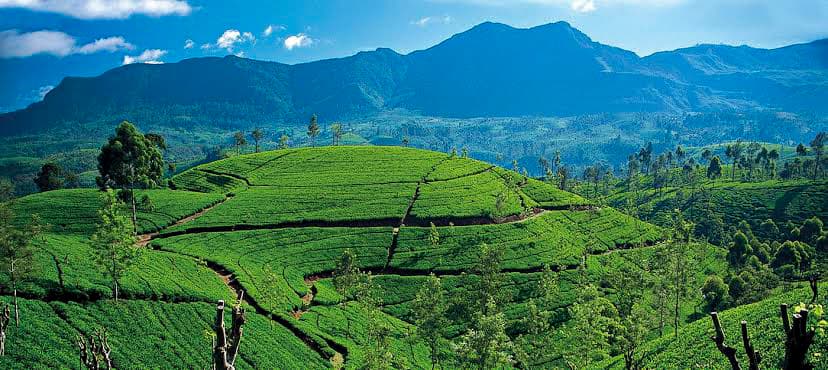
The British built a hill station here at 1,868 metres to escape the heat. What they left behind --- the racecourse, the mock-Tudor hotels, the rose gardens --- sits incongruously among some of the finest tea land on earth. The mist rolls through in the afternoon and does not always leave. The mornings are cold enough to see your breath.
Walk the estate rows at dawn --- the light in the high country at 6am, the mist lifting from the valley below, the Tamil tea pluckers beginning their day. The tasting at the end is a genuine education.
The colonial-era lake surrounded by eucalyptus and pine, with morning walks and quiet boat rides.
A two-hour walk through tea country reaching a waterfall that drops into a valley of extraordinary depth.
One of the most reliable sites in Sri Lanka for endemic highland birds --- the Kashmir flycatcher, the Indian blue robin, and the Sri Lanka white-eye.
Kandy
The last kingdom. Still the cultural capital.
Kandy resisted European colonisation for over three hundred years. The Temple of the Tooth at its centre houses the most sacred relic in the Buddhist world. The lake beside it was built by the last king. The mountains around it make the city feel held --- cooler than the coast, operating at a rhythm that the lowlands do not share.
Three daily puja ceremonies (6am, 11am, 6.30pm) fill the air with drumming, flute, and incense. The 6am ceremony, before the tourist buses arrive, is the one worth attending.
Walk the perimeter at dusk --- the cloud wall behind the hills, the reflection of the temple lights in the water, the monks crossing the causeway.
An evening performance of Kandyan dance, fire-walking, and traditional drumming. The fire-walking sequence, which closes the programme, is performed without apparent injury.
147 acres containing one of the finest collections of tropical plants in the world. The avenue of royal palms. The giant Java fig whose single tree covers half an acre.
Sigiriya
The rock that changes the way you see everything else.
There is no preparation for Sigiriya. The jungle opens and five hundred feet of ancient rock rises from the plain without ceremony. A 5th century king built a palace on its summit and decorated the sheer rock face with frescoes of extraordinary beauty. The frescoes remain. The hydraulic gardens at the base --- among the oldest landscaped gardens on earth --- still function on their original irrigation system.
Begin at dawn. The light on the plain from the summit at 6.30am is unlike anything the island offers from ground level. The climb takes 90 minutes.
Halfway up the rock, protected in a sheltered gallery --- semi-divine women painted in colours that have not faded in fifteen centuries. They must be seen slowly.
The world's earliest identifiable example of visitor commentary --- inscriptions left by visitors between the 6th and 14th centuries. Some are poetry. All are fifteen hundred years old.
The symmetrical water gardens, fed by an ancient hydraulic system that still pressurises the fountains after 1,500 years. Walk them in the early morning.
Climb the lower rock opposite for the sunrise view of Sigiriya's profile. The finest photograph available in Sri Lanka and almost no one takes it.
Dambulla
The cave that the jungle did not swallow.
A granite outcrop rising from the jungle floor shelters five cave temples cut directly into the rock --- the finest collection of Buddhist cave paintings and sculpture in Asia. The caves have been continuously active as a place of worship for over two thousand years. 153 Buddha statues, three reclining Buddhas, and wall paintings covering every surface of the caves from floor to ceiling.
Enter barefoot, as visitors have for two thousand years. Five caves, 2,100 square metres of painted rock surface. The incense and the sound of monks chanting are not ambient details --- they are the experience.
Carved directly from the rock. The painting behind it --- an unbroken 15-metre canvas of Buddhist cosmology --- covers every inch of the ceiling and walls.
Water seeps through the rock ceiling and drips into a golden vessel below. It has been dripping continuously for at least two thousand years. No one has adequately explained why the rock does not absorb it.
A 180-degree view of the Cultural Triangle plain. On a clear morning, Sigiriya Rock is visible on the horizon. The final stop on the Southern Slow Road. The cave temples at Dambulla --- two thousand years of devotion on a rock ceiling --- are the correct final encounter with the island's interior knowledge. The island's last word to the departing guest.
Local photographer for 2 hours, digital images delivered, Point reef break session
2-hour guided kayak, elephant and crocodile encounters, waterbird watching
2-hour lesson with experienced local instructor, all boards provided
Floating deck at dusk on the Bentota River, Sri Lankan feast, lanterns, boat transfer
Dawn transport to Nuwara Eliya estate, table in the rows at first light, estate tea
Private table on the western rampart at sunset, 3-course dinner, wine pairing
Cinnamon Air scenic loop over Sigiriya and the Cultural Triangle, 30--45 minutes
All-property briefing, room arrangements, sparkling wine, private dining experience
All Essential plus: 2 private dining, Ayurvedic treatment, Cinnamon Air seat, photography, journey book
Scheduled service, saves 5 hours road travel, scenic hill country approach