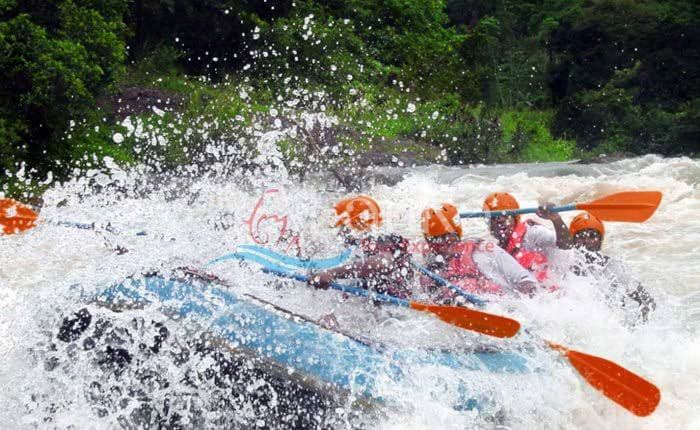
At Kithulgala, strap in and let the white water make the decisions. At Adam's Peak, begin the climb at 2am. Arrive at the summit as the light breaks across the central highlands in every direction. Then descend --- through Ella, to Mirissa, to Galle --- having earned the coast completely. This is a journey for guests who want to feel the island, not photograph it through a bus window.
Pinnawala Elephant Orphanage
Fully described in Package 03, Stop 9.
The Highland & Coast Escape begins at Pinnawala --- the river bathing, the orphaned calves --- before turning southeast toward Kithulgala and the river. Allow a morning; the afternoon is the drive to Kithulgala.
Kithulgala
The river that does not negotiate. The jungle that was here before the road.
Kithulgala is a small town on the Kelani River in the wet zone foothills --- where the mountains begin their descent from the central highlands and the rainfall is high enough to keep the jungle dense and the river fast. The white water rafting section of the Kelani River here --- Grade 3 to 4 depending on rainfall --- is the finest in Sri Lanka. The same jungle was used as the filming location for David Lean's Bridge on the River Kwai in 1957.
The full rafting section runs approximately 6km and takes 2 hours. The Grade 4 sections require no previous experience but do require a willingness to be out of control for approximately 8 seconds at a time. The guides are experienced and safety-certified.
A morning trek with a birding guide offers the Sri Lanka blue magpie, the red-faced malkoha, and the green-billed coucal in the same two hours. Among the best wet zone endemic birding in Sri Lanka.
The bridge pylons from the 1957 film are still in the river. The jungle still looks exactly as it did in 1957 --- a small, accurate data point about the rate of change in this part of Sri Lanka.
A 45-minute trail to Duwili Ella --- plunge pools deep enough to swim and cold enough to matter after a morning on the river.
Adam's Peak --- Sri Pada
The climb that three religions agree upon. The sunrise that justifies the 2am start.
Adam's Peak is 2,243 metres tall and carries, at its summit, a rock formation that Buddhists venerate as the footprint of the Buddha, Hindus as the footprint of Shiva, and Muslims and Christians as the footprint of Adam. The climb --- 5,500 steps from the base --- takes 3 to 5 hours. It must be begun at 2am to reach the summit for sunrise. The pilgrimage season runs from December to May.
Begin at the Dalhousie trailhead at approximately 2am. The steps are lit during peak season. The path is shared with Buddhist and Hindu pilgrims who have been making this same climb for a thousand years.
In the minutes before sunrise, the peak casts a triangular shadow across the landscape to the west that is mathematically perfect. It lasts approximately 15 minutes. Then it dissolves. From the summit, on a clear morning, both coastlines are visible simultaneously.
The footprint at the summit --- 1.8 metres long --- is covered by a small shrine and surrounded by bells that pilgrims ring on arrival. Three traditions coexist here without tension, which is itself a statement about what the mountain has been for a thousand years.
Ella
The village that sees everything and has decided to stay small.
Ella sits at the edge of the hill country, where the mountains drop away suddenly and the southern plain stretches to the horizon. The famous Nine Arch Bridge was built by locals using granite and brick during World War I when steel was unavailable. It is still in daily use.
The bridge crossing times are known to your guide. Arrive 20 minutes early. Stand on the tea estate path above the bridge, not below it. The train crosses in 40 seconds.
A 3-hour return hike through tea estates and jungle to a summit overlooking the Ella Gap and the southern plain. A guide is necessary, not optional.
A 45-minute walk with a sunrise view of the entire southern hill country.
One of the most beautiful rail journeys in the world. Second class observation car --- the windows open further.
Mirissa
The blue whale surfaces sixty metres away. Everything stops.
Mirissa is the departure point for one of the great wildlife encounters available to any traveller anywhere on earth. The blue whale --- the largest animal that has ever existed --- feeds in the waters off the southern coast between November and April. The whale watching boats depart at 6am and return by noon.
Ophiro uses a responsible operator --- a smaller boat, a biologist on board, no chasing or circling. The blue whale surfaces for three to five breaths, then dives for fifteen minutes. At sixty metres' distance, it requires no superlatives.
Schools of several hundred dolphins ride the bow wave. The spinner dolphin's aerial display appears to be done for pleasure.
A curved bay with a small rocky island at one end and coconut palms along its length. The afternoon after a whale watching morning, with fresh grilled cuttlefish at a beach table.
Galle
The most beautiful colonial fort in Asia. Still a living city inside its walls.
Galle Fort was built by the Portuguese in 1588 and expanded by the Dutch in 1663. The best-preserved colonial sea fort in Asia --- a UNESCO World Heritage Site containing, inside its 36 hectares of ramparts, a living community of restaurants, galleries, boutiques, residences, and a functioning lighthouse.
The full perimeter walk takes 45 minutes. The western rampart facing the open ocean should be saved for dusk. The stone turns gold, the Indian Ocean reflects the sky, and the lighthouse clicks on.
The 1755 Dutch Reformed Church with its original black and white marble floor tiles. The streets retain the original Dutch grid and carry the original Dutch names.
Handloom textiles, lacework, batik, Ceylon sapphires, and the work of contemporary Sri Lankan designers in spaces occupied by craftspeople since the 17th century.
Colombo
The city that survived everything and is still deciding what it wants to be.
Colombo is layered, contradictory, and increasingly vital --- a city that carries Portuguese, Dutch, British, Moorish, Tamil, and Sinhalese histories in its street grid, its architecture, its food, and its people without resolving them into anything coherent.
Each street sells one category of goods. The commerce of a city of 800,000 people moves through it daily. Walk it with a guide. Do not try to navigate it alone.
Kite sellers, food carts, families, lovers. The sun sets directly over the ocean here. It is the correct way to end a journey through Sri Lanka.
Colombo's restaurant scene has developed significantly in the last decade. Your guide will know where the city is eating right now, not where it was eating last year.
Private small boat, marine biologist, breakfast at sea, max 12 guests
Full-day canyon descent with local operator, abseiling, natural water slides, guide
Specialist summit guide, porter for bags, headlamps, emergency kit, hot tea at summit
Private table on the western rampart at sunset, 3-course dinner, wine pairing
Linen table on private beach section, catch of the day, champagne, dedicated server
Dawn transport to estate, table set in the rows at first light, estate tea and fresh bread
Cinnamon Air scenic loop over Adam's Peak, 30--45 minutes, pilot narration
All-property briefing, room arrangements, sparkling wine, private dining experience
All Essential plus: 2 private dining, Ayurvedic treatment, Cinnamon Air seat, photography, journey book