Jaffna is not on the standard itinerary. That is why it is on this one. The north carries a cultural depth --- Tamil heritage, ancient temples, the lagoon light at dusk --- that the south does not replicate. Kalpitiya offers dolphins before breakfast. Wilpattu offers leopards without the convoy. This is the journey for guests who have already done Sri Lanka once and know there is more. There is always more.
Kalpitiya
Dolphins before breakfast. Kite surfers by noon. The peninsula that does not advertise itself.
Kalpitiya is a narrow peninsula on the north-west coast, flanked by the Puttalam Lagoon on one side and the Indian Ocean on the other. Between November and April, spinner dolphins gather in the channel between the peninsula and the Bar Reef Marine Sanctuary in pods of several hundred --- sometimes several thousand --- animals.
The early morning boat reaches the dolphin grounds within 30 minutes. The pods here are dramatically larger than anything seen off Mirissa or Trinco. A pod of 500 spinner dolphins riding the bow wave, leaping and spinning around the boat for 45 minutes.
The Puttalam Lagoon provides flat water, consistent wind, and a long shallow run ideal for beginners. Afternoon sessions when the sea breeze builds are the correct time.
One of the largest coral reef systems in Sri Lanka, gazetted as a marine sanctuary in 1992. The reef supports hawksbill sea turtles, leopard sharks, and coral recovering from protected status.
The fishing communities of the peninsula --- predominantly Muslim, with a Catholic minority descended from Portuguese settlement --- live on a sandbar a few hundred metres wide in places.
Wilpattu National Park
The leopard without the convoy. The jungle as it actually is.
Wilpattu is the largest national park in Sri Lanka and the least visited by mainstream tourism. The leopard population here is significant --- and because visitor numbers are lower than Yala, sightings happen at a respectful distance without jeep convoys. The park's defining feature is its villus --- natural lakes formed by rainwater --- surrounded by dense jungle. The park was closed for nearly two decades due to the civil conflict and reopened in 2010, having regrown without human disturbance. It is denser, wilder, and more authentic than almost anywhere else in Sri Lanka's national park system.
Unlike Yala, it is unusual to see more than three or four other vehicles on the same track. The leopard sightings at Wilpattu are quieter, longer, and more intimate.
The natural lakes support painted storks, lesser adjutants, purple herons, and multiple species of kingfisher. Slow time at a villu edge, binoculars up, in silence.
Wilpattu's elephants are wilder and less habituated to vehicles than those at Minneriya or Udawalawa.
Jaffna
The island's second culture. Present for two thousand years. Visible to tourists for barely a decade.
Jaffna was effectively inaccessible to most travellers until 2009. The city at the northern tip --- Tamil in culture, Hindu in religious life, connected to South India by language and lineage --- is unlike any other part of Sri Lanka. The food is different. The architecture is different. The temples are different. Jaffna has decided, for the most part, not to change for tourists. That is the point of going.
The most important Hindu temple in Sri Lanka, dedicated to Lord Murugan, continuously worshipped for over a thousand years. The dawn and evening pujas --- drums, bells, incense, oil lamps --- are the correct experience. Remove shoes at the outer gate.
Categorically different from Sinhalese cooking. The use of palmyra palm products alongside dry zone vegetables and the fish of the northern lagoon produces a culinary tradition with no equivalent elsewhere on the island. Lunch in a family home, not a restaurant.
Built by the Portuguese in 1618 and expanded by the Dutch --- considered the most strategically important position in Ceylon. The largest Dutch colonial fortification in Asia. Star-shaped design and dry moat largely intact.
The Jaffna Lagoon contains 41 islands. Nainativu --- reached by a 45-minute ferry --- holds the Nagapooshani Amman Kovil, worshipped for over two thousand years. The ferry journey through the lagoon is as valuable as the temple.
Trincomalee
The finest natural harbour in Asia. The warmest water on the east coast.
Trincomalee's deep natural harbour has been contested by every colonial power that arrived in the Indian Ocean. The Portuguese built a fort here. The Dutch took it. The British made it the headquarters of the Eastern Fleet. What surrounds the harbour today: beaches and bays of exceptional quality, warm clear water supporting coral reef and whale shark populations.
Pigeon Island National Park, 300 metres offshore, contains the best-preserved coral reef on Sri Lanka's coast. Blacktip reef sharks, sea turtles, and reef fish in clear warm water.
The clifftop temple stands at the point where the Portuguese threw the original Hindu temple into the sea in 1624 and built a fort on its ruins. Three religions, one cliff, four centuries of history.
The waters off Trinco's east coast attract whale sharks between March and October. The largest fish in the ocean. At five metres' distance in clear water, it requires no superlatives.
Seven artesian wells of varying temperatures located 8km from Trinco. The temperature difference between adjacent wells of a few metres apart remains unexplained.
Sigiriya and Dambulla
The rock that changes the way you see everything else.
There is no preparation for Sigiriya. The jungle opens and five hundred feet of ancient rock rises from the plain without ceremony. A 5th century king built a palace on its summit and decorated the sheer rock face with frescoes of extraordinary beauty. The frescoes remain. The hydraulic gardens at the base --- among the oldest landscaped gardens on earth --- still function on their original irrigation system.
Begin at dawn. The light on the plain from the summit at 6.30am is unlike anything the island offers from ground level. The climb takes 90 minutes.
Halfway up the rock, protected in a sheltered gallery --- semi-divine women painted in colours that have not faded in fifteen centuries. They must be seen slowly.
The world's earliest identifiable example of visitor commentary --- inscriptions left by visitors between the 6th and 14th centuries. Some are poetry. All are fifteen hundred years old.
The symmetrical water gardens, fed by an ancient hydraulic system that still pressurises the fountains after 1,500 years. Walk them in the early morning.
Climb the lower rock opposite for the sunrise view of Sigiriya's profile. The finest photograph available in Sri Lanka and almost no one takes it. *Dambulla - The cave that the jungle did not swallow.* A granite outcrop rising from the jungle floor shelters five cave temples cut directly into the rock --- the finest collection of Buddhist cave paintings and sculpture in Asia. The caves have been continuously active as a place of worship for over two thousand years. 153 Buddha statues, three reclining Buddhas, and wall paintings covering every surface of the caves from floor to ceiling.
Enter barefoot, as visitors have for two thousand years. Five caves, 2,100 square metres of painted rock surface. The incense and the sound of monks chanting are not ambient details --- they are the experience.
Carved directly from the rock. The painting behind it --- an unbroken 15-metre canvas of Buddhist cosmology --- covers every inch of the ceiling and walls.
Water seeps through the rock ceiling and drips into a golden vessel below. It has been dripping continuously for at least two thousand years. No one has adequately explained why the rock does not absorb it.
A 180-degree view of the Cultural Triangle plain. On a clear morning, Sigiriya Rock is visible on the horizon.
Kandy and Ella
The last kingdom. Still the cultural capital.
Kandy resisted European colonisation for over three hundred years. The Temple of the Tooth at its centre houses the most sacred relic in the Buddhist world. The lake beside it was built by the last king. The mountains around it make the city feel held --- cooler than the coast, operating at a rhythm that the lowlands do not share.
Three daily puja ceremonies (6am, 11am, 6.30pm) fill the air with drumming, flute, and incense. The 6am ceremony, before the tourist buses arrive, is the one worth attending.
Walk the perimeter at dusk --- the cloud wall behind the hills, the reflection of the temple lights in the water, the monks crossing the causeway.
An evening performance of Kandyan dance, fire-walking, and traditional drumming. The fire-walking sequence, which closes the programme, is performed without apparent injury.
147 acres containing one of the finest collections of tropical plants in the world. The avenue of royal palms. The giant Java fig whose single tree covers half an acre. *Ella - The village that sees everything and has decided to stay small.* Ella sits at the edge of the hill country, where the mountains drop away suddenly and the southern plain stretches to the horizon. The famous Nine Arch Bridge was built by locals using granite and brick during World War I when steel was unavailable. It is still in daily use.
The bridge crossing times are known to your guide. Arrive 20 minutes early. Stand on the tea estate path above the bridge, not below it. The train crosses in 40 seconds.
A 3-hour return hike through tea estates and jungle to a summit overlooking the Ella Gap and the southern plain. A guide is necessary, not optional.
A 45-minute walk with a sunrise view of the entire southern hill country.
One of the most beautiful rail journeys in the world. Second class observation car --- the windows open further.
Ahangama
The south coast's quietest surf town. The correct place to end this particular journey.
Ahangama sits on the south coast between Weligama and Galle --- distinct enough from both to have its own character. The town has a local surf scene, a fishing harbour that operates at 4am, and a beach that has not been fully colonised by tourism. After the north, Ahangama offers the decompression that the end of a long journey requires.
The reef breaks around Ahangama --- Kabalana and Midigama --- are intermediate-level right-handers for surfers ready for something more demanding than the Weligama beginner break.
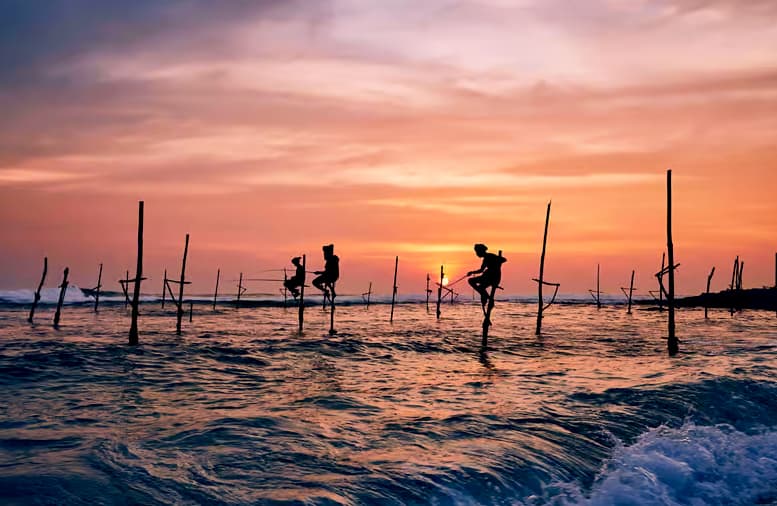
The Ahangama fishing fleet launches before dawn. The harbour at 4am is the south coast in its working register. Thirty minutes here gives the journey its correct final image of the island.
The full Galle Fort experience is 20 minutes from Ahangama. A final afternoon in Galle, having completed the journey through the north, gives the Fort's colonial history a context that visiting it at the beginning of a trip cannot.
Morning boat, pods of 300--500 dolphins, Bar Reef view, light breakfast
VDWS-certified instructor, flat lagoon, afternoon wind session, all equipment
Return ferry through the Jaffna Lagoon, pilgrimage temple visit, guide accompanies
Home-cooked Tamil cuisine in a Jaffna family home, guide introduction, recipe discussion
Linen table on private beach, fresh south coast seafood, champagne, dedicated server
Local surf photographer for 2 hours, digital images delivered, reef break session
All-property briefing, room arrangements, sparkling wine, one private dining experience
All Essential plus: 2 private dining, Ayurvedic treatment, Cinnamon Air seat, photography, journey book
Scheduled air service, saves 5--6 hours road travel, scenic flight over the Cultural Triangle