The southern coast does not rush. It simply offers --- the warmest water in the Indian Ocean, the unhurried pace of a place that knows it is beautiful. This journey earns that coast. It moves through surf towns and safari roads, highland tea country and ancient elephant corridors, before arriving at the south having understood what it means. Ten days is the ideal. Seven days is possible. The south is the reward either way.
Colombo
The city that starts the journey.
The Grand Loop begins in Colombo --- the Pettah market in the morning, Galle Face Green at dusk --- before heading south along the coast road. Allow half a day.
The city that survived everything and is still deciding what it wants to be.
Colombo is layered, contradictory, and increasingly vital --- a city that carries Portuguese, Dutch, British, Moorish, Tamil, and Sinhalese histories in its street grid, its architecture, its food, and its people without resolving them into anything coherent.
Each street sells one category of goods. The commerce of a city of 800,000 people moves through it daily. Walk it with a guide. Do not try to navigate it alone.
Kite sellers, food carts, families, lovers. The sun sets directly over the ocean here. It is the correct way to end a journey through Sri Lanka.
Colombo's restaurant scene has developed significantly in the last decade. Your guide will know where the city is eating right now, not where it was eating last year.
Bentota
The river town the coast road passes through. Slow down here.
Bentota sits at the confluence of the Bentota River and the Indian Ocean --- a lagoon town with a river on one side and a beach on the other. Brief Gardé, a Dutch colonial mansion at the river mouth, gives Bentota its correct architectural tone.
A two-hour boat journey through mangrove channels that progressively narrow until the canopy closes above. Kingfishers, water monitors, estuarine crocodiles at close range and low speed.
Bentota beach between November and April has calm, flat, warm water --- ideal for swimming and paddleboarding.
A genuine research and rehabilitation effort for five sea turtle species. The experience of watching a loggerhead hatchling enter the Indian Ocean for the first time is not theatrical.
Weligama
The bay where Sri Lanka learned to surf.
Weligama is a wide, flat bay with a wave that breaks gently across its entire width, making it the finest beginner surf location in Sri Lanka. The stilt fishermen who once lined the bay on their poles have become one of the iconic photographs of Sri Lanka.
The Weligama wave is consistent, not too fast, and breaks on sand rather than reef. Two hours with a local instructor will have most first-time surfers standing by the end of the session.
The original stilt fishermen work the eastern end of the bay before 6am. Arrive early. The photographs taken in that hour are not the staged versions.
A private island 100 metres from the beach --- a 1920s villa that has hosted Pablo Neruda and Arthur C. Clarke. The view of Weligama Bay from its summit garden is one of the finer south coast perspectives.
Yala National Park
Fully described in Package 01, Stop 7.
On the Grand Loop, Yala arrives after the south coast surf towns --- the shift from salt water and beach to dry zone jungle and leopard is one of the journey's most effective gear changes. Dawn safari, leopard tracking, elephant herds, sloth bear at dusk. See Package 01 for full experience descriptions.
Arugam Bay
The east coast's answer to everywhere else.
Arugam Bay is on the east coast, separated from the south by the Yala jungle corridor. The journey from Yala to Arugam Bay takes three hours through dry zone scrub and feels like arriving in a different country. The east coast has a different light, a different wind, a different culture.
The Arugam Bay Point break works best between May and September when the south-west swell arrives. An experienced surfer's first morning should be spent watching from the headland before paddling out.
The lagoon supports wild elephants, estuarine crocodiles, and an extraordinary waterbird population. A dawn kayak through the lagoon channels is one of the finest wildlife experiences on the east coast.
The cuisine of Arugam Bay reflects its east coast Tamil and Muslim heritage. Your guide will know which roadside stall is the correct one.
A 2,000-year-old Buddhist temple on a small promontory south of the bay, overlooking the ocean. Seldom visited by tourists. Entirely genuine.
Ella and Nuwara Eliya
Ella - The village that sees everything and has decided to stay small.
Ella sits at the edge of the hill country, where the mountains drop away suddenly and the southern plain stretches to the horizon. The famous Nine Arch Bridge was built by locals using granite and brick during World War I when steel was unavailable. It is still in daily use.
The bridge crossing times are known to your guide. Arrive 20 minutes early. Stand on the tea estate path above the bridge, not below it. The train crosses in 40 seconds.
A 3-hour return hike through tea estates and jungle to a summit overlooking the Ella Gap and the southern plain. A guide is necessary, not optional.
A 45-minute walk with a sunrise view of the entire southern hill country.
One of the most beautiful rail journeys in the world. Second class observation car --- the windows open further. *Nuwara Eliya - The city of light. Six thousand feet above the sea, inside the clouds.* The British built a hill station here at 1,868 metres to escape the heat. What they left behind --- the racecourse, the mock-Tudor hotels, the rose gardens --- sits incongruously among some of the finest tea land on earth. The mist rolls through in the afternoon and does not always leave. The mornings are cold enough to see your breath.
Walk the estate rows at dawn --- the light in the high country at 6am, the mist lifting from the valley below, the Tamil tea pluckers beginning their day. The tasting at the end is a genuine education.
The colonial-era lake surrounded by eucalyptus and pine, with morning walks and quiet boat rides.
A two-hour walk through tea country reaching a waterfall that drops into a valley of extraordinary depth.
One of the most reliable sites in Sri Lanka for endemic highland birds --- the Kashmir flycatcher, the Indian blue robin, and the Sri Lanka white-eye.
Kandy
The last kingdom. Still the cultural capital.
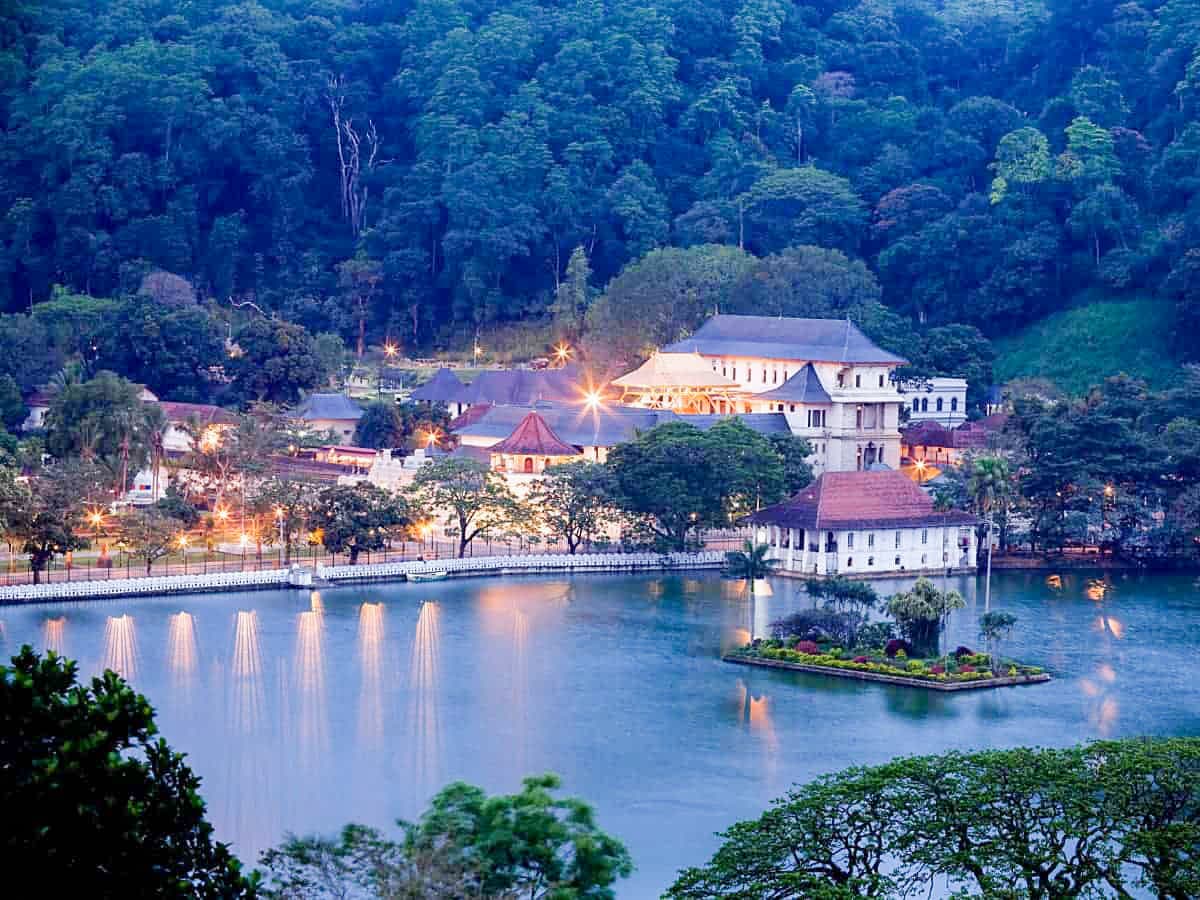
Kandy resisted European colonisation for over three hundred years. The Temple of the Tooth at its centre houses the most sacred relic in the Buddhist world. The lake beside it was built by the last king. The mountains around it make the city feel held --- cooler than the coast, operating at a rhythm that the lowlands do not share.
Three daily puja ceremonies (6am, 11am, 6.30pm) fill the air with drumming, flute, and incense. The 6am ceremony, before the tourist buses arrive, is the one worth attending.
Walk the perimeter at dusk --- the cloud wall behind the hills, the reflection of the temple lights in the water, the monks crossing the causeway.
An evening performance of Kandyan dance, fire-walking, and traditional drumming. The fire-walking sequence, which closes the programme, is performed without apparent injury.
147 acres containing one of the finest collections of tropical plants in the world. The avenue of royal palms. The giant Java fig whose single tree covers half an acre.
Pinnawala Elephant Orphanage
Not a zoo. A sanctuary that has been operating since 1975.
Pinnawala is the Department of Wildlife Conservation's elephant orphanage --- established in 1975 to care for wild elephants orphaned, injured, or abandoned. The herd currently numbers over 90 animals.
The herd walks to the Maha Oya River twice daily (10am and 2pm). For 45 minutes, 90 elephants of all ages bathe, play, drink, and interact in open water at close range.
The youngest orphaned calves are bottle-fed at scheduled intervals. A complex animal that has survived separation and trauma, accepting food from a trusted mahout.
Sigiriya
The rock that changes the way you see everything else.
There is no preparation for Sigiriya. The jungle opens and five hundred feet of ancient rock rises from the plain without ceremony. A 5th century king built a palace on its summit and decorated the sheer rock face with frescoes of extraordinary beauty. The frescoes remain. The hydraulic gardens at the base --- among the oldest landscaped gardens on earth --- still function on their original irrigation system.
Begin at dawn. The light on the plain from the summit at 6.30am is unlike anything the island offers from ground level. The climb takes 90 minutes.
Halfway up the rock, protected in a sheltered gallery --- semi-divine women painted in colours that have not faded in fifteen centuries. They must be seen slowly.
The world's earliest identifiable example of visitor commentary --- inscriptions left by visitors between the 6th and 14th centuries. Some are poetry. All are fifteen hundred years old.
The symmetrical water gardens, fed by an ancient hydraulic system that still pressurises the fountains after 1,500 years. Walk them in the early morning.
Climb the lower rock opposite for the sunrise view of Sigiriya's profile. The finest photograph available in Sri Lanka and almost no one takes it.
Habarana and Minneriya
The elephant gathering. The largest terrestrial wildlife spectacle in Asia.
Between August and October, the Minneriya reservoir becomes the focal point of what is called The Gathering: up to 300 wild elephants congregate as the surrounding jungle dries and the water level drops, exposing fresh grassland. They arrive in family groups, meet other groups, and interact in a way that has no parallel on the island.
The evening safari, starting at 3pm and running until dusk. The number of animals visible from a single position --- 50, 100, occasionally 200 or more --- in open grassland is unlike any other wildlife experience in Sri Lanka.
Bicycle tours through working paddy fields, traditional pottery operations, and the daily agriculture of the dry zone. A morning on a bicycle before the heat builds.
Polonnaruwa
The second great capital. Better preserved than Anuradhapura, and understood differently.
Polonnaruwa became the new capital of the Sinhalese kingdom in the 10th century. Its golden age under King Parakramabahu I (1153--1186 CE) produced structures that survive in better condition than almost anything at Anuradhapura.
Four figures --- a seated Buddha, a colossal standing Buddha (15 metres), a reclining Buddha at the moment of Parinirvana, and a smaller seated figure --- cut from a single granite face.
Hire bicycles from the entrance and navigate the ancient city at your own pace. The distances between structures are 500 metres to 2 kilometres --- cycling through the jungle is the correct way to understand it.
The sea of Parakrama covers 2,500 hectares and was the engineering centrepiece of the Polonnaruwa kingdom. Walking its embankment at dusk, with the ancient ruins silhouetted behind.
Negombo
The journey ends where the island begins.
Most guests pass through Negombo without pausing. That is a mistake. The lagoon town just north of the airport carries centuries of Portuguese and Dutch colonial history, a fishing culture so old its methods predate European arrival, and a morning fish market that begins before dawn and is finished before the tourists wake.
Arrive before 5.30am. The catch arrives by boat and is auctioned within the hour. Entirely authentic --- commerce that has operated identically for generations.
The Negombo Lagoon at dusk --- Chinese fishing nets lowering and rising, egrets crossing the sky --- is the island's first quiet moment and one of its best.
The remains of the Dutch fort and the canal built to transport cinnamon. A slow walk at golden hour reveals the colonial geography of the town.
Built by the Portuguese in the 16th century, rebuilt by the Dutch. Ceiling paintings are remarkable. The fishing community that fills it on Sunday mornings is more remarkable still.
The freshest catch in Sri Lanka is here, not on the southern coast. Lagoon prawns, grilled fish, coconut sambol --- the correct introduction to Sri Lankan cuisine.
Private small boat, max 12, marine biologist on board, breakfast at sea
Private exclusive jeep, resident naturalist, evening gathering session
2-hour guided kayak through wildlife channels, elephant and crocodile encounters
Floating deck at dusk, Sri Lankan feast, lanterns, boat transfer to and from
Linen table on private beach, 3-course seafood menu, champagne
Lunch in a local family home, guide introduction, market visit optional
All-property briefing, room arrangements, sparkling wine, private dining experience
All Essential plus: 2 private dining, Ayurvedic treatment, Cinnamon Air seat, photography, journey book
Scheduled seaplane, saves 5+ hours road travel, direct route